The Number Doesn't Know What It's Doing

Why analyst price targets — and your own entry price — are two of the most dangerous anchors in investing
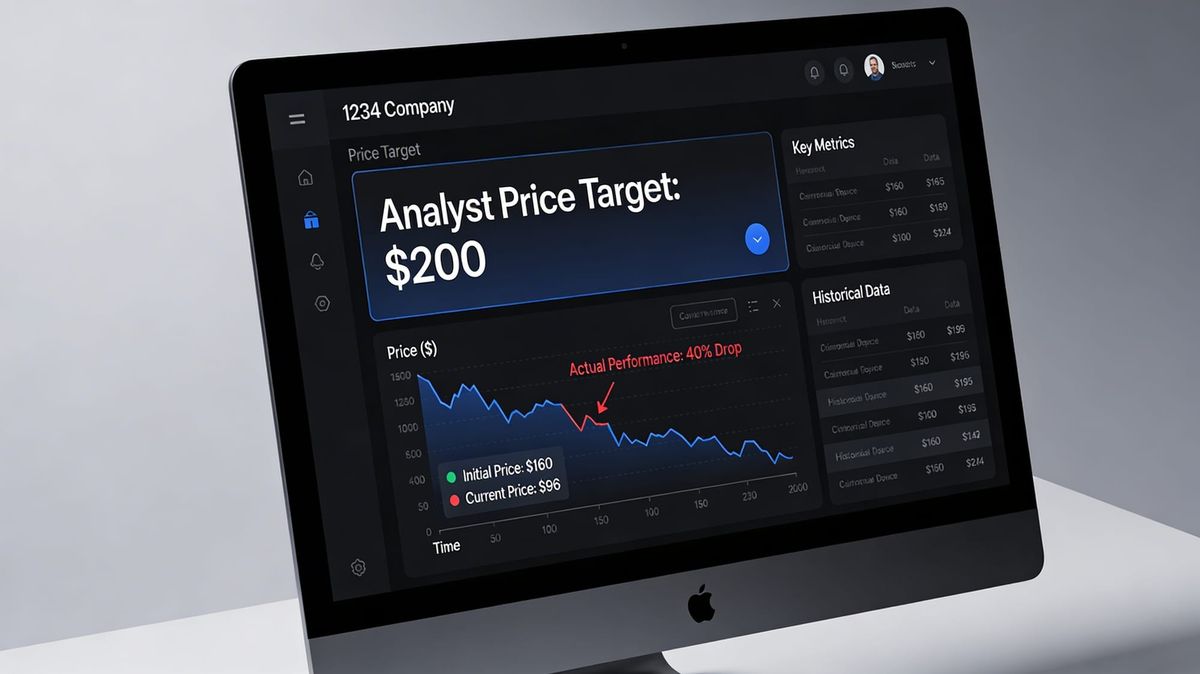
There's a belief that sounds reasonable on the surface: "The analyst said $X, so that's where this stock is headed." Or the other version — the one we do to ourselves: "I bought at $80, the stock has since dipped, so I need to hold until it gets back to $80." An arbitrary number we picked, now running our decision-making.
Both feel like logic. Neither is.
They're anchors. And anchors don't tell you where you're going — they just tell you where someone thought you'd go, or where you've already been. The market doesn't care about either number.
The Scout Who Had No Idea
In 2013, the Cleveland Cavaliers held the first overall pick in the NBA Draft. Most analysts and front offices expected that pick to be Victor Oladipo — a proven two-way guard from Indiana who went on to make the All-Star game. Anthony Bennett, a power forward from UNLV, wasn't even on most people's radar as a likely #1 pick. But the Cavaliers took him anyway. ESPN's Bill Simmons, live on television the moment the pick was announced, reportedly said "I need medical help."
That reaction was warranted. Bennett played only four seasons in the NBA, averaging 4.4 points per game, and has been named the worst number-one pick in league history. In his rookie year, he averaged 4.2 points, shooting 25% from behind the arc and 35% from the field.
The scouting reports weren't completely blind. His versatility as a scorer from every level made him an intriguing option. Capable of handling the ball with either hand, he ferociously attacked the basket throughout his freshman season and shot well above league average from three-point range. The analysis saw something. It just dramatically overestimated how that skillset would translate. And it missed one critical thing no spreadsheet measures: whether a player will actually push himself when it gets hard.
Then there's Markelle Fultz. The #1 pick in the 2017 draft, selected by the Philadelphia 76ers, was projected to be a franchise-altering point guard — the next Allen Iverson, some said, a complete scorer and shot creator who could anchor an offense for a decade. Then a mysterious shooting breakdown emerged almost immediately after he entered the league. His mechanics deteriorated so badly that basic free throws became a genuine concern. He eventually landed in Orlando, where he's carved out a serviceable career — but the franchise-changing player those projections described never showed up.
Two number-one picks. Two sets of well-resourced, professional analysts who spent months studying film, running metrics, watching workouts. Both projections were confidently wrong — not about players who suffered freak injuries, but about fundamental questions of translation, character, and development that even the most detailed scouting report cannot reliably answer.
They're People. So Are the Analysts.
This is the part nobody says out loud: analysts — in sports and in finance — are people. They have résumés, credentials, and access to data most of us don't. But they're not scientists running controlled experiments, and they're certainly not prophets. They have blind spots, incentive structures, and the same fundamental problem we all share: they're making confident statements about an uncertain future.
A scout can't see what happens to a player when the money clears and the pressure mounts. An equity analyst can't see a pandemic ending, or ChatGPT launching, or a CEO's behavior shifting public sentiment overnight. The model is only as good as the assumptions that go into it — and the assumptions are always human. That's not a criticism. It's just the truth. And it's important to hold onto when someone hands you a number and calls it a target.
Now Open Your Brokerage Account
In April 2022, ARK Invest — one of the most-followed investment firms in the country — published an updated price target on Tesla. Cathie Wood-led ARK Investment Management said it expects Tesla stock to hit $4,600 by 2026, up from its current price of $985 a share. The firm projected Tesla would sell 17 million electric vehicles by 2026 in a bull scenario, with robotaxi revenue contributing more than half of Tesla's expected value.
That was a specific, public, confident number from a credentialed firm with serious research backing it.
By 2025, Tesla's stock was trading around $250–$320. Tesla's stock price is currently far below even the bearish scenario ARK simulated in 2021, and it would have to increase by 806% to hit the bear case scenario for 2026 that was projected in 2022.
Not the bull case. The bear case. The worst-case scenario they modeled. The stock missed that too.
To be fair to ARK, modeling a speculative growth company five years out is genuinely difficult. That's actually the point. The confidence of the number — the precision of $4,600, the "best case" of $5,800, the bear case floor of $2,900 — none of it reflected the real uncertainty underneath it. It looked like a forecast. It was a story dressed in a dollar sign.
Peloton tells the same story from a different angle. At its peak in late 2020 and into 2021, the connected fitness company was a Wall Street darling. Analysts had price targets ranging from $100 to over $160 a share. The pandemic had sent subscription numbers soaring, and the analysis extrapolated that growth forward with confidence. The 12-month stock price target is $8.05. The stock currently trades around $4–6.
That's a collapse from over $160 to under $6. The analysts weren't lying or lazy. They couldn't see that pandemic-era buying behavior was a one-time pull-forward of demand, not a new baseline. The model had no way to know that people would go back to gyms. The number was built on an assumption, and the assumption was wrong.
The Second Anchor: The One You Set Yourself
Analyst targets are at least someone else's bad math. The entry price anchor is your own.
It goes like this: you buy a stock at $80. It drops to $55. Instead of asking "Is this stock worth owning at $55?" — the only relevant question — you start asking "How do I get back to $80?"
That $80 number isn't a market level. It's a psychological hostage situation. The stock has no memory of where you bought it. The market doesn't care. And every decision filtered through that anchor distorts your thinking — you hold longer than you should, you average down into a deteriorating thesis, or you sell a winner too early because it "already came back."
The same trap works in the other direction. Buy at $40, watch it run to $90, and suddenly $90 becomes your new anchor. A pullback to $70 — which might be a completely healthy retracement with the thesis intact — gets processed as a $20 loss instead of a 75% gain. Panic selling follows, not because the trade is broken, but because the anchor shifted.
Price doesn't consult your feelings. It moves on supply, demand, liquidity, and catalysts. Not cost basis. Not someone's 12-month model.
So What Do You Actually Use?
Not targets. Not your entry. Here's what has a better track record:
Structure. Where has price historically found buyers and sellers? Those levels reflect where real money made real decisions — not where an analyst thinks price should go.
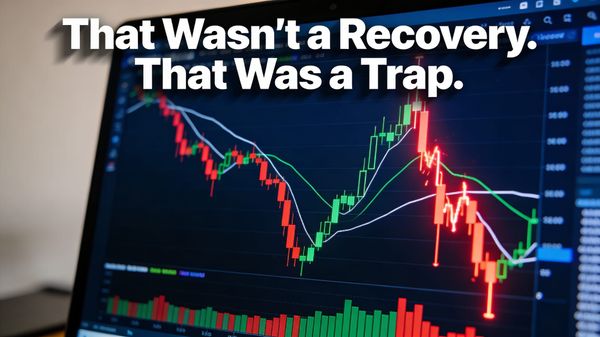
Technicals. Fair value gaps, key moving averages, prior highs and lows, volume — these are actual footprints of market activity. They're not perfect, but they're grounded in what the market has already done.
A defined invalidation point. Instead of a price target, ask: "At what point is my reason for being in this trade wrong?"Set that level before you enter. When price crosses it, you exit — not because a number disappointed you, but because the thesis broke.
Analysts are useful for one thing: building a narrative around why something might be worth watching. The specific number at the end of that narrative? Treat it like a rough first draft. It's a starting point based on assumptions — and the market has a long history of making those assumptions look silly.
The Takeaway
Anthony Bennett looked like a versatile scorer on film. Markelle Fultz looked like a franchise point guard on paper. ARK's model said $4,600. Peloton's model said $160. None of it survived contact with reality.
The number isn't the thesis. The number is just someone's best guess, dressed up in a dollar sign to make it feel official. The more precise the number, the more confident it sounds — and the more likely it is that you're being handed certainty that doesn't exist.
Trust structure. Manage risk. Define your exit before your entry. And treat any 12-month price target — from a Wall Street firm or your own head — as information, not instruction.
The Less Intimidating is a financial education blog built for people who are tired of being talked down to. Nothing here is financial advice. Everything here is an honest conversation.